
Lago Alianza Newsletter – April 2026
Para leer en español, seleccione la bandera en la esquina superior de su pantalla.
Stay updated with the Lago Alianza newsletter!
Sign up to receive our newsletter via email.
Giving with Confidence: How to Know a Nonprofit is Legitimate in Mexico
People who live in the Lake Chapala region are generous. Many of us arrived here wanting to give back, and over the years we have supported schools, animal rescues, health programs, food banks, and many other worthwhile efforts. Along the way, however, most longtime residents have also heard stories of projects that disappeared, organizations that dissolved, or funds that were never fully accounted for.
Recently, someone wrote to Lago Alianza with a question that many people share: How can you tell if a nonprofit in Mexico is legitimate? It is an important question, and the answer is not always simple.
Different legal structures in Mexico
In Mexico, charitable groups exist at many different levels of formality. Some begin as informal efforts - a small group of people helping neighbors, animals, or a school. These groups may do very good work, but they often operate without a formal legal structure, sometimes using personal bank accounts or cash to manage expenses.
As organizations grow, some register as an Asociación Civil (A.C.), which creates a legal entity separate from an individual. An A.C. can open its own bank account and has certain reporting obligations, but it is not the same as a fully regulated nonprofit in the United States or Canada.
A smaller number of organizations obtain Donataria Autorizada status, which allows donations to be tax-deductible in Mexico and requires more oversight by the federal tax authority (SAT). These organizations are subject to stricter reporting requirements and greater transparency.
With early stage organizations often the founder and friends and family fund the organization. They are intimately connected with the mission and the work. As the organization grows, less knowledgeable donors have many ways to build confidence. Especially with larger gifts donors can meet with the principals and get a feel for how disciplined the group is in identifying and executing its mission and providing financial transparency. Donors attend Annual General Meetings and ask questions. And seeing the organization over time gives a donor a chance to see how solid their decision-making process is, how they handle the unexpected and how they handle leadership transitions. Every organization has the potential to lose focus and effectiveness over time as well as grow in strength and impact. The steps a group takes toward formalization normally does indicate a broader leadership group, more individuals responsible for the group’s decisions and more potential for succession of leadership. These, like formal organization, do not guarantee success but they set the foundation for its possibility.
The reality is that the nonprofit sector in Mexico, especially at the local village level, is still developing. Many dedicated volunteers focus on helping others first and formal structure later. While this does not mean an organization is mishandling finances, it can make it harder for donors to evaluate accountability.
What Lago Alianza does and does not do
Lago Alianza was created to strengthen the nonprofit community, not to act as a funding agency.
In most cases, we do not give money directly to organizations. Instead, we offer training, consulting, and collaborative programs designed to help nonprofits become more professional, more sustainable, and more transparent over time.
Because of this role, we do not require groups to meet a specific legal standard in order to participate in our educational programs. In fact, part of our mission is to help organizations understand the steps needed to become legally compliant and financially stable.
When funding is involved, additional vetting is required
Lago Alianza is affiliated with the Chapala Nonprofits Donor Advised Fund, which provides financial support to selected projects in the region.
Obtaining a tax deductions for a foreign charity is more complicated than in the states where if you give to a 501(c)(3) the tax deductions is automatic so long as you obtain acknowledgement of your gift. To ensure tax deductibility of a US donation to most Lakeside groups (there are a couple that are already themselves 501(c)(3) organizations in the states) an intermediary is required to be sure IRS requirements are fulfilled. CAF is one such intermediary.
When funding is requested through this program, organizations must go through a formal review process conducted by CAF America, an international organization that evaluates charities in more than 135 countries.This review may include examination of legal status, financial records, governance, reputation, and how funds will be used. In many cases, funding is approved only for specific projects, and organizations must report on how the money was spent. Reviews are repeated periodically so that approval is not based only on past history.
No system can guarantee that problems will never occur, but independent vetting provides a much higher level of confidence for donors.
A community effort
Building a strong nonprofit sector takes time. It requires legal structure, financial transparency, good governance, and ongoing education - and those things do not happen overnight in any community.
At Lago Alianza, our goal is to support the organizations that are doing good work today while also helping them become stronger, more accountable, and more sustainable for the future.
We welcome questions about this topic, and we encourage thoughtful giving. A healthy nonprofit community depends on both generous donors and responsible organizations, working together with trust and clarity.
Reaching Donors: Connecting with American & Canadian Ex-Pat Supporters
On the north shore of Lake Chapala, generosity often arrives with a passport. There are many expats in this area, but the question is, how do we actually reach them?”
While most American and Canadian residents are retired, many seek out ways to give back to their adopted and welcoming new community and use their skills and resources. Many are retired professionals, former nonprofit board members, Rotarians, teachers, business owners. They are used to giving. They are used to volunteering. They just need to know where they fit.
Lago Alianza is actively working to educate the donors at Lakeside through weekly social media posts, our nonprofit directory, spotlights and specific outreach efforts and seeing if new tools for donors could be made available, such as mechanisms for legacy gifts and tax deductions for Canadian taxpayers.
Below are some suggestions for jumpstarting your efforts and reaching expats.
Go where they already are.
English-language Facebook groups. Community newsletters. Rotary meetings. Church bulletins. The message boards at popular cafés. Instead of asking for money right away, invite them to something small: a tour, a coffee, a one-hour information session. An invitation feels better than a solicitation.
Use introductions, not announcements.
The most effective outreach often starts with, “Would you introduce us to your friends?” A living-room gathering with ten thoughtful people can turn into steady support for years. Trust grows in conversation, not in mass emails.
Be specific about impact.
Simply asking “Can you support our mission?” is too vague. Instead, use real world examples about how a donation can make an impact, such as “$75 provides one month of meals for a senior”. This is clear, concise, and relatable.
North American donors are used to seeing where their money goes. If you can show that plainly, even in a simple one-page summary, you’re ahead of the game.
Offer real volunteer roles.
Many ex-pats have decades of professional experience. Instead of “We need volunteers,” try:
- “We need someone to help review our bookkeeping once a month.”
- “We’re looking for help writing a short donor update.”
- “Could you mentor our program coordinator?”
Skill-based roles can help a potential volunteer feel needed and meaningful. Be honest about taxes.
If donations are deductible, explain how. If they aren’t, say so clearly. Transparency
builds trust faster than perfection ever will.
Remember the calendar.
Seasonal residents are most active November through April. That’s when to host events and volunteer drives. Year-end giving (December) is especially important for U.S. and Canadian donors.
Lead with partnership.
Most ex-pats don’t want to “rescue” anyone. They want to support local leadership and be part of something constructive. When you frame your work as community-led and sustainable, you invite people into something healthy.
At the end of the day, this isn’t about sales and marketing, it’s about meaningful and mutually beneficial relationships. The generosity is already here. The bridge just needs to be built.
Nonprofit Spotlight: Chapala Sunrise Rotary Club, A.C.
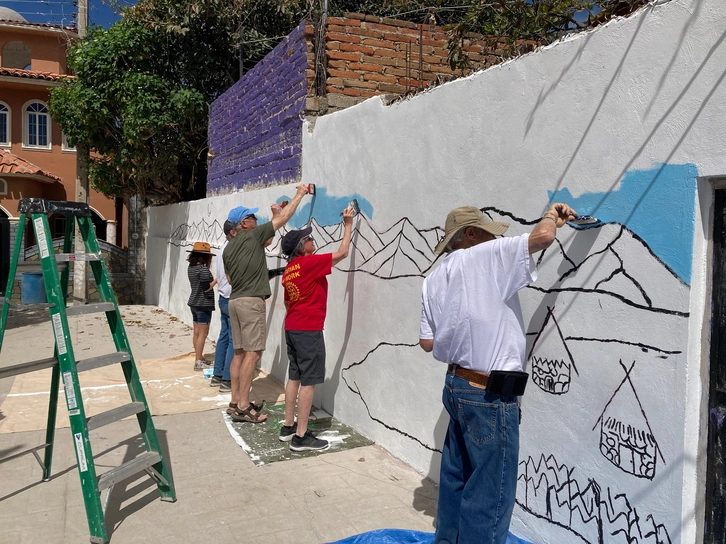
Since 2014, Chapala Sunrise Rotary Club, A.C. has been quietly but steadily making a difference in communities across Lakeside, with a hands-on approach that combines volunteer service, education, and large-scale community projects. The club primarily serves Chapala and the eastern Lakeside villages, including Tepehua, Ojo de Agua, La Cuesta, and San Pedro Itzicán, working closely with schools, community centers, and local organizations.
Unlike many nonprofits, Chapala Sunrise Rotary operates with no paid staff and more than 50 active volunteers, allowing the group to put the vast majority of its resources directly into projects. Members describe the organization as a true “boots-on-the-ground” effort, with volunteers actively involved in the communities they serve rather than working only behind the scenes.
Projects that make a lasting impact

Over the years, the club has taken on a wide range of initiatives, from education and health outreach to civil engineering projects that improve daily life for entire villages. One of their most significant accomplishments was completed in July 2025, when the club finished a multi-year wetlands sanitation system in Ojo de Agua. The project now treats all of the village’s wastewater, preventing raw sewage from flowing into Lake Chapala. The construction work was paired with two years of community education on water safety, sanitation, and long-term maintenance of the system.
Health education is another ongoing priority. Since 2018, the club has operated a Diabetes Clinic and education program in Chapala, helping participants learn how to manage their condition through nutrition, monitoring, and lifestyle changes. Several attendees have improved their health to the point that they no longer require medication.
The club has also partnered with the Lila K Foundation and Hospital Civil to support kidney transplant patients, helping identify donors and fund procedures for people who would otherwise not have access to treatment. To date, the program has assisted with 17 successful transplants, many benefiting indigenous patients.
Working together with other nonprofits
Collaboration is a central part of the Rotary approach. The club currently works on children’s feeding programs and scholarships, project management and accounting, and are developing collaborations with local nonprofits. Members also assist each year with the Feria de Maestros event and regularly coordinate with other local organizations to share resources and volunteers.
Managing growth and complexity
With projects funded by donors and Rotary clubs in Mexico, the United States, and Canada, the organization handles multiple currencies, banking systems, and reporting requirements. Maintaining transparency with donors and meeting the documentation standards required by Mexican tax authorities (SAT) requires careful coordination. Recently, the club reorganized its leadership structure to divide financial and administrative responsibilities into several roles, including the creation of an Outreach Coordinator position to improve communication with donors and partners.
A volunteer-driven community
Chapala Sunrise Rotary is a membership-based organization whose members pay annual dues and meet weekly in Chapala. Meetings are held every Thursday at 10:00 a.m. at Restaurante La Palapa de Don Juan on the Malecón, and visitors are welcome to attend. The group welcomes people who want to be actively involved in community projects, whether or not they speak fluent Spanish.
Over the past four years, the club has raised and invested more than 8 million pesos in local projects, and they are currently seeking funding for the restoration and equipment of a medical clinic in La Cuesta, a project estimated at 2.5 million pesos.
For those looking for a way to serve the community while building friendships and working side-by-side with others, Chapala Sunrise Rotary offers exactly that — a chance to turn good intentions into real, visible change across Lakeside.
 For more information visit: chapalarotary.org